Anne G. Fredericks featured in the Berkshire Eagle's Berkshire Week

The origin of haloes
By Kate Abbott, Berkshires Week Editor
Thursday December 22, 2011
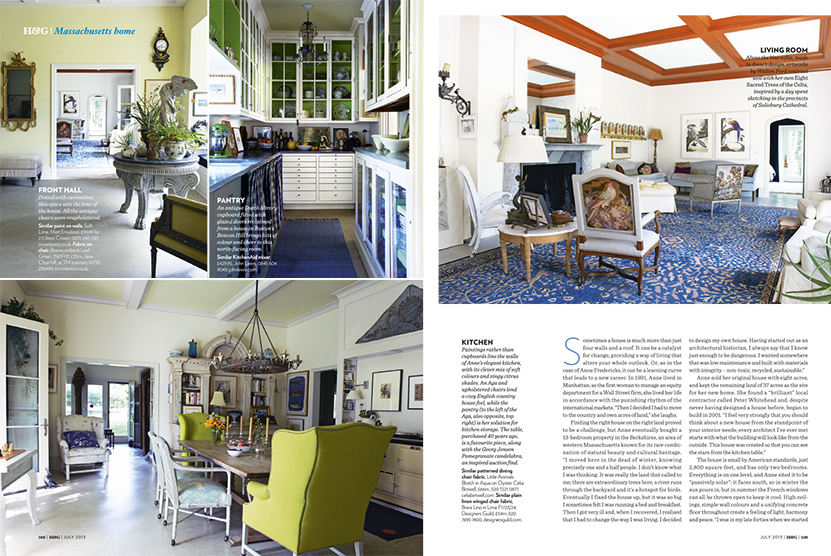
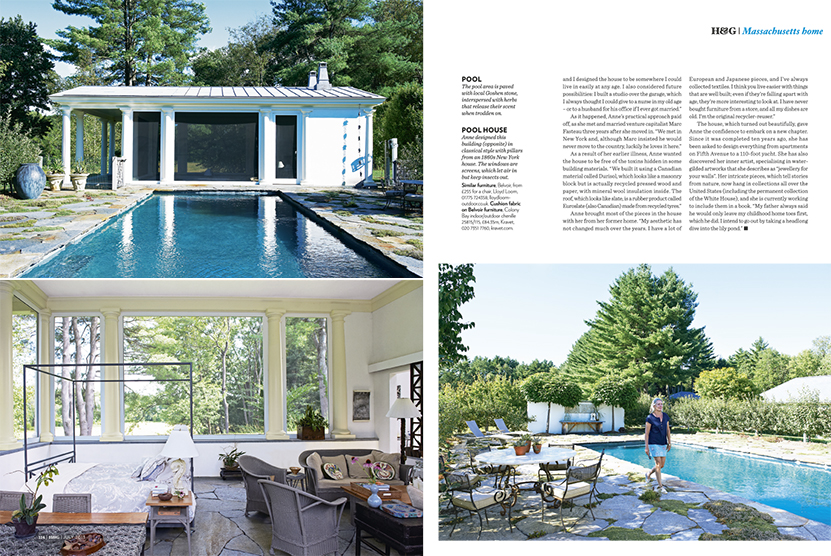
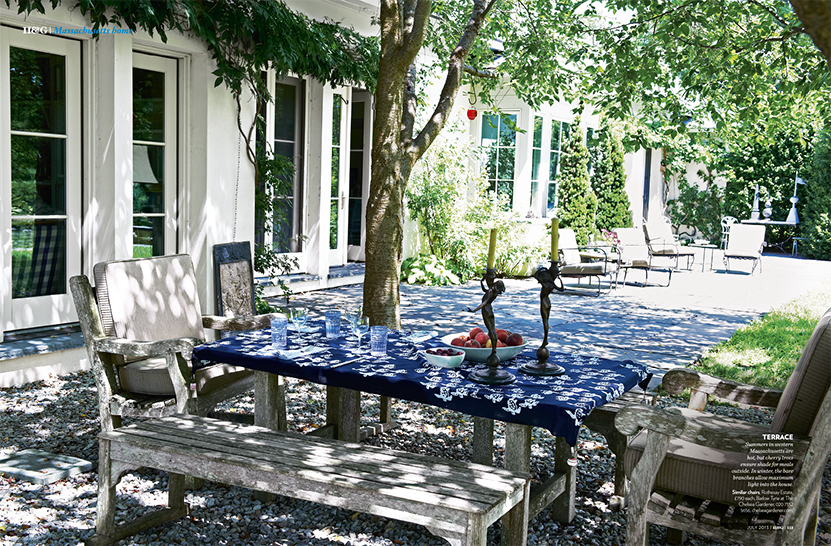
GREAT BARRINGTON — Imagine a 15th-century night. With a lamp or a candle, walk into an unlit room. Hold up the light. In the solid darkness, on the walls, faces glow — looking down at a child, or looking up in prayer. Maybe this is why medieval crafters inlaid altars with gold. So at the midnight mass on Christmas eve, people could see the saints. Great Barrington artist Anne Fredericks has re-invented this centuries-old art: water gilding, the craft of treating wood with gold leaf and burnishing it to a high gloss. “For centuries we lived in low light at night,” she said. Anything that could catch light, and throw light, was highly prized.
“Places where they would just have a lantern, and you have a serving dish or a writing box with gold on it — it would shimmer,” she said. “There was a sense of wonder about this light thrown off — some people believed the gold had a light in it — a vibrating light.” “It fascinates me how we’re attracted to light. We need some dim light, some darkness, to appreciate it.” All of her work tells stories, she said — not from the Christian gospels, but from the fresh water ponds and meadows near her house and from her childhood. Across from her fireplace, golden stars gleam in a dark square around a mirror. She calls this work “Sagitta” for the constellation, the arrow, and the flowering plant with arrow-like leaves that blooms here when Sagitta rises in the night sky. As fresh-water ponds grow scarcer, so does the Sagitta flower, she said. This piece is not about looking in the mirror, for her, but about steeping through it, like Alice in the looking glass, into the kind of place where people bathe on a summer night in a pond, with minnows and dragonflies, and snails on the banks.

Anne G. Fredericks Art Sagitta
“Everything has a story about what we’re potentially losing,” she said. She likes the feel of working with natural materials, she said — a base of wood, a gesso of marble dust and hide glue, a surface of clay, tempera paint, and the gold. And all of her work tells a stories. The stories keep her involved with each piece through the painstaking months of putting it together, she said. She takes weeks to prepare the wood surface with gesso and a water-based glue and to coat it with delicate films of gold. A fragment of gold leaf clings to the skin like cloth. Rub it and it vanishes, with only a glimmer of a smudge on a fingertip. “It takes enormous patience,” she said. What has drawn her to learn the craft, through trial and error, and to spend six to eight months on a single piece? “It’s about the light,” she said, “about the beautiful sheen.” She has always loved sunlight and brightness in artwork “My mother could make anything with a needle,” she said. “She made vestments with gold thread.” A very little gold thread could transform the cloth. Later, Fredericks discovered the gilded panels of Boutet-Monveil’s book on Joan of Arc, the gloss of laquerwork and the sunlit paintings of Joaquín Sorolla. She wanted to work with gold. Very few people practice water gilding anywhere in the world. So, with a degree in art history and with stubborn patience, she set out to teach herself. “I thought, I can master a craft, and there will be an artfulness about it,” she said. Some parts of the world value highly this craft, and the time and care in any craft.
In Kyoto, Japan, a year ago she was taken to meet a gilder who creates kimonos for the royal family. He works in his grandfather’s workshop, using tools his grandfather used and made. She watched him work. He wasted nothing, she said — gathering up the tailings, fragments of gold, and pulverizing them to shake over laquer. “He is very highly regarded,” she said. “People come from all over the world to work with him.” America does not have this kind of tradition, she said. In America, artists have often separated art from craft and held the idea of a work higher than the skill in shaping it. But after half a century of expressionists and minimalists, she believes American artists are coming around again to value patience and hands-on skill. “We are looking for some integrity,” she said. “I think there’s room for beauty in art.” After two world wars, she explained, people thought beauty was dead — but no one can live in that darkness for too long. “Artists are supposed to make sense of their culture,” she said. “Some beauty would be good for all of us right now.”
~ By Kate Abbott, Berkshires Week Editor
In my interview with Kate Abbott for her article in the Berkshire Eagle, reproduced here, we discussed some of the inspirations that moved me to choose gilding as a form of expression. I have been studying art history since high school and looking at art even longer. I was consistently attracted to certain things:
This started at home, watching my mother make things with her needle: She sewed vestments with gold thread.

Embroidered Vestment (this is not a vestment made by my Mother but very similar)
I also went to Mass at school where I sometimes served as an altar boy. I got a good look at the priest’s embroidered vestments while kneeling near them on the altar

My 1967 Needlepoint pillow
In my teens, 1967, I designed this pillow with my Mother. It is an adaption of Peter Max’s ubiquitous work of the time. No gold threads but lots of golden hues.
My childhood books were a constant inspiration

Ida Bohatta Illustration
Ida Bohatta’s little German books with stars and moons. I also loved HA Rey’s book “Find the Constellations” there was a tiny caricatured boy who would show the mythological forms in the constellations and who would identify the stars in the night sky. I still have this book which I take out in the summer to show small visitors. I loved the idea of all the pictures in the sky above us. It stayed with me as I studied Greek mythology later at school.

Jeanne D'Arc M. Boutet De Monvel
This book fascinated me. There were bits of gold everywhere in the illustrations. Imagine my surprise and delight when I discovered the original paintings were in the Corcoran Museum in Washington DC where I attended art school in the ’70’s. Was he inspired by Paolo Uccello, whose paintings of battles and silvered lances also inspire me?

Bilbin Folk Emboidery
Ivan Bilbin was a big favorite. His illustrations were rich in gold detail: the tail of the firebird, gilded spires and onion domes, golden fish and this, one of his many peasant scenes, with richly colored and embroidered costumes.

Vincent Van Gogh Wheatfield with Crows
When I was in school, my kindergarden teacher, Blanche Canto, was also the high school art history teacher. When I was in 2nd grade, she took us to see a retrospective on Van Gogh. I very clearly remember standing in front of those Sunflowers. I have been looking at art ever since. In my travels, I always sought out art, not just paintings, but beautiful objects as well. There are several artworks that helped me towards gilding:

Chapel of the Magi-Benozzo Gozzoli
Nothing beats these frescoes from the 15th century. I spent days in Florence in the 1970’s visiting this small space over and over again.

Joaquim Sorolla Boys on the Beach, 1910
Sorolla’s work is suffused with golden light. No one can paint light like Sorolla: on skin, on water, a sunbeam on the side of a woman’s face.

Odilon Redon Evocation

Odilon Redon Virgin with a Halo
Odillon Redon captured in his pastels and distemper paintings the intense blues I Iove. He used Pastels to mimic gold, putting highlights in lovely dark scenes.

Jewel Box by Dagobert Peche
Have you seen this? Peche’s objets, furniture and drawings are fantastic in the true sense of the word.

Chinoiserie Wallpaper, golden mirror and candlelight
The darkened rooms and chapels where gilded objects glistened, glimmered and captivated me on so many levels.

Details of a Kyoto Screen I purchased in Japan in 1986, 74" wide x 28" 1/2
The screen depicts Japanese books and scrolls using antique Japanese fabrics. The background is gold paper. My Japanese piano teacher gave me my first book on Japan, a book of Japanese crafts when I was in the 3rd or 4th grade. Later, Masako Kondo, a Japanese ikebana master let me visit in her studio and home in Royal Oak Michigan. There I saw her beautiful kimonos with golden threads and pottery with flashes of gold. I studied Japanese art in High school and College, then found myself traveling to Japan every year from 1984-1991. In some years I was in Japan several times, it was then that I saw the objects I had studied and admired.

Writing Box by Ogata Korin (17th c)
I was always interested in the Japanese use of gold in lacquerware, kimonos and screens. More importantly, their belief in living with few, but beautiful, useful objects led me to make my first gilded and painted mirrors, jewelry for your walls. From there, the gilding grew to include panels, altars, and constructions. The Japanese work and live in lower light. In these environments, their golden objects shimmer and appear to throw off light. Last year I spent one month in Japan, where I saw more of the countryside and also worked in Kyoto with a Japanese gilder who gilds for the Imperial Family.

Me (Anne G. Fredericks) gilding in Japan 2010

Gilding Master, Kyoto 2010
These are some of the visuals that inspired me to design my first mirror in 1989 and then to continue for the last 20 years to explore ways to use and design with gold leaf.
Berkshire Eagle article: http://www.berkshireeagle.com/berkshiresweek/ci_19597691
For more information on the process of water gilding please see my Water Gilding blog entry: http://annefredericks.com/category/water-gilding